OT / ICS / SCADA Security

Built for OT.
Not adapted from IT.

No agents. No active scanning. No cloud dependency. No operational disruption. Security that works with your environment, not against it.

The OT Challenge

IT security tools don’t belong in OT environments.

Most cybersecurity was designed for IT: agentable, cloud-connected, update-friendly. OT environments are none of those things – and the wrong tool can be more dangerous than no tool at all.

Legacy Systems You Can’t Touch

PLCs, RTUs, and SCADA systems running decades-old firmware can’t accept agents or patches. Any security tool that requires a software install is a non-starter – full stop.

Downtime Is Not an Option

A security tool that causes a process disruption in a water treatment plant or power substation isn’t a security tool – it’s a liability. Fail-safe operation is mandatory, not optional.

Air-Gap & Connectivity Constraints

Remote sites – pumping stations, substations, field cabinets – often operate with no reliable WAN connectivity. Cloud-dependent security is no security at all when the link drops.

How It Works

Passive. Protocol-native. Proven.

PacketViper RSUs (Remote Security Units) are compact, ruggedized appliances that install passively in field cabinets – between the switch and the uplink. They see everything. They touch nothing. They enforce silently.

There’s no software to install on your controllers, no cloud dependency for enforcement, and no active scanning that could trip a PLC. Just visibility, intelligence, and inline control where you need it most.

No Agents Required

Passive inline installation – RSUs see all traffic without touching a single endpoint or requiring software on any OT device.

Protocol-Aware Enforcement

Deep packet inspection for OT protocols: Modbus, DNP3, BACnet, S7COMM, NTCIP, EtherNet/IP, IEC 61850, OPC-UA, HART, and Profinet – with field-level command visibility.

Fail-Safe Operation

Hardware bypass mode ensures traffic continues uninterrupted even if the RSU loses power or encounters a fault. Operations never stop because of us.

RSUs in Field Cabinets

DIN-rail mountable, ruggedized enclosures fit standard OT field cabinets. No dedicated rack space, no IT infrastructure required at the remote site.

SCADA Integration via Modbus

Native Modbus integration means your SCADA platform can pull security telemetry directly – no middleware, no custom integration work, no vendor lock-in.
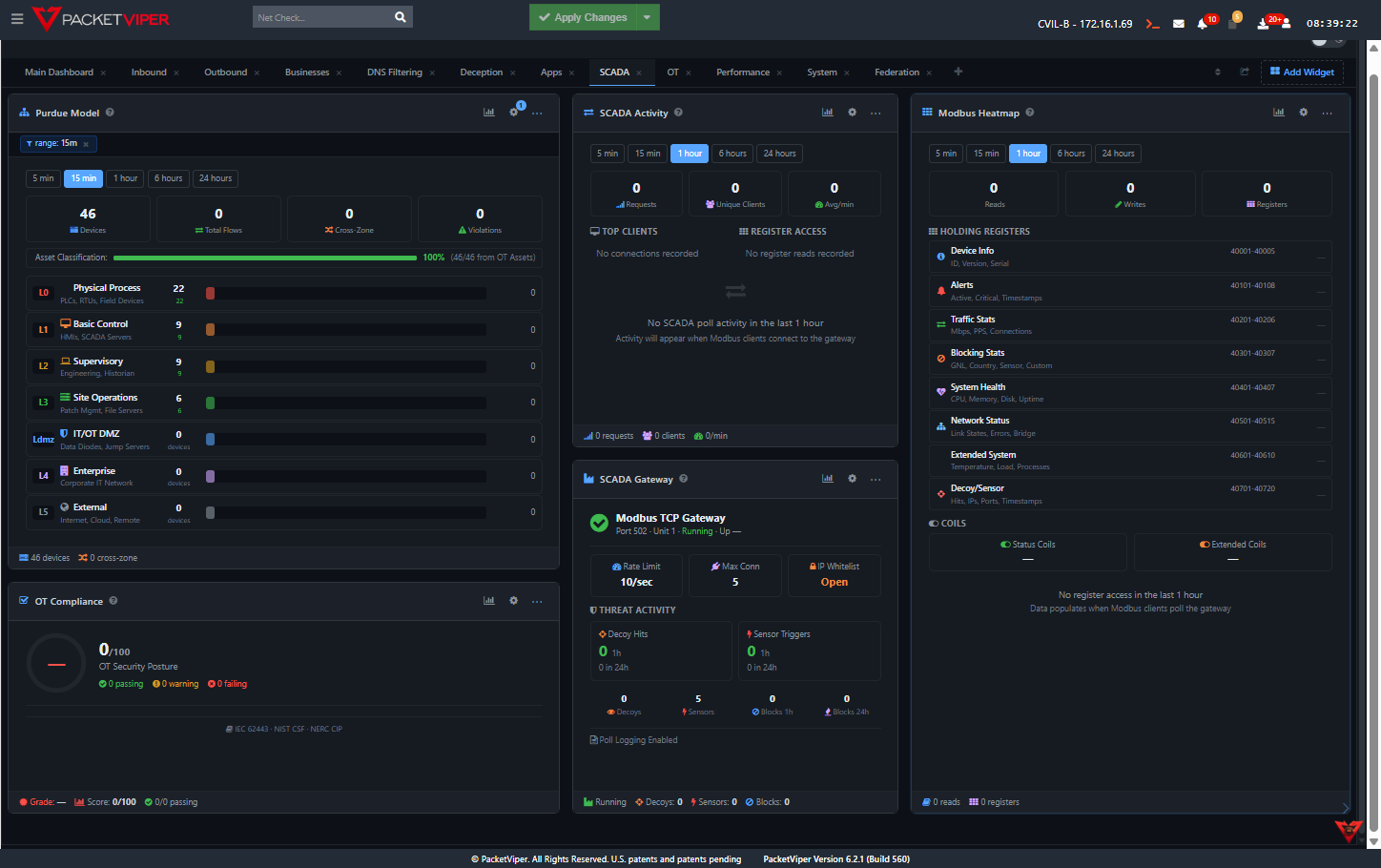
PacketViper OT Security Dashboard - protocol monitoring and enforcement
RSU Deployment Model

A single RSU protects an entire remote site – substation, pump station, or manufacturing cell. Zero cloud dependency. Autonomous enforcement.

All connections
Block/allow by protocol
OT protocol commands
Rate-limit threats
Recon detection
Autonomous isolation
Protocol Support

Your protocols. Natively understood.

PacketViper doesn’t treat OT traffic as generic TCP flows. Each supported protocol is parsed and inspected at the command and register level – so you see what’s actually happening, not just that a connection occurred.

Modbus DNP3 BACnet S7COMM NTCIP EtherNet/IP IEC 61850 OPC-UA HART Profinet

Additional protocol support available. Contact us for a full capability list.

The CPS Test

Four questions. Ask your current vendor.

Most OT security platforms can’t answer all four of these without caveats. PacketViper can – and does, autonomously.

The Four Questions Every OT Operator Should Ask

These aren’t theoretical threat scenarios – they’re the real-world events that happen at remote substations, pump stations, and field sites every day. If your security platform can’t answer “yes” to all four, you have a gap.

  1. If someone plugs into an unmanaged switch at a remote site – does your system detect it immediately?
  2. Can it limit network access from that site in real time?
  3. Can it isolate or stop the connection without calling anyone?
  4. Does it alert your operators automatically?
PacketViper RSUs answer yes to all four. Autonomously. Without central management.
0
Connections/Sec (CPS)
0
Events/Sec (EPS)
Full pipeline throughput
0
CPU Idle
At Peak Load
20–30%
Immediate Traffic Reduction
Get Started

See what your firewall never told you.

Book a live demo – we’ll show you exactly how it works.

What makes OT network security different from IT security?

OT security must prioritize availability – a false positive disrupting a PLC controlling water treatment can be as damaging as a successful attack. Security tools cannot use agents, cannot perform active scanning, and must understand OT protocols like Modbus, DNP3, and BACnet. OT systems have decades-long lifecycles where patches are rare.

What OT protocols does PacketViper natively support?

PacketViper natively supports Modbus TCP/IP, DNP3, BACnet, S7COMM, and NTCIP. Native support means PacketViper understands function codes and whether commands match expected engineering activity – enabling accurate enforcement without false positives that could disrupt operations.

Can PacketViper protect OT devices without installing software on them?

Yes. PacketViper is entirely agentless – it operates at the network layer, requiring no software on any protected device. This is critical where PLCs, RTUs, and HMIs cannot support agents and where modifying certified industrial firmware is operationally and contractually prohibited.

How does PacketViper protect remote unmanned OT sites?

The Remote Security Unit (RSU) is a ruggedized industrial appliance deployed at unmanned sites – pump stations, substations, well pads. Each RSU operates autonomously: detecting threats, enforcing containment, and alerting even when disconnected from the CMU. A detected threat triggers enterprise-wide block propagation instantly.

How does PacketViper support NERC CIP compliance?

PacketViper's Deceptive Responders and inline monitoring align with NERC CIP-015-1 Internal Network Security Monitoring requirements. The platform provides forensic-level logging, audit trails, and compliance reporting, while compensating control capabilities address legacy OT devices that cannot be patched.